
The TLI Rail Mutual Recognition project was designed as a two-phase body of work to support implementation of a rail mutual recognition scheme of entry level skills across Australia.
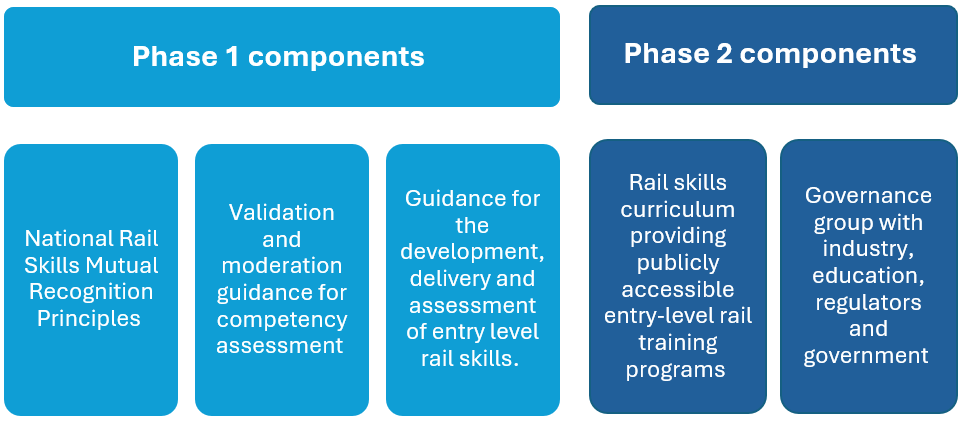
Phase 1 has been completed, covering three of the five components outlined in the blueprint for mutual recognition of nationally recognised standardised entry-level rail skills training and assessment in Australia, developed by the National Transport Commission (NTC) in 2024.
During Phase 1, it became clear that while rail operators supported mutual recognition, they preferred a mandatory approach rather than a voluntary one. As a result, many operators were reluctant to agree to participate in a mutual recognition scheme, or to adopt the guidelines until governance arrangements were confirmed.
In August 2025, Australia’s Infrastructure and Transport Ministers agreed to several key harmonisation actions. The newly formed Australian Rail Industry Standards Organisation (ARISO) will lead the development of harmonised standards that support interoperability.
This harmonisation work will also begin addressing domain specific operating rules which have been identified as a barrier to mutual recognition.
Looking ahead, ISA will continue to work closely with the NTC to determine the appropriate timing for commencing Phase 2 of the project.
Rail skills training and assessment is often tailored to the rail organisation, railway network and geographic location. This includes entry level rail skills training and assessment. There are examples of training and assessment that have been highly contextualised to meet an organisation’s local product and domain needs which then restricts the transferability to other networks. As a result, there is limited mutual recognition of the existing skills and training of rail workers.
For workers, the absence of mutual recognition hinders their ability to move between employers and presents a barrier to entry into the sector.
For employers, the absence of mutual recognition means that they are required to retrain workers because there is no clear separation of common skills and knowledge from local product and domain skills and knowledge.
To reduce training time and costs for Australia’s rail transport operators, the National Transport Commission (NTC) developed a Blueprint for mutual recognition of nationally recognised entry level rail skills training. The Blueprint report gathered insights from industry, education sector stakeholders, and regulators through collaborative workshops. The Blueprint outlined five steps to achieve mutual recognition of entry-level rail competencies across Australia.
The blueprint analysed over thirty (30) rail career pathways to identify common units of study. This analysis identified two (2) core entry-level skill sets comprised of nine (9) associated Units of Competency:
- TLISS00128 Rail Infrastructure Induction Skill Set
- TLISS00224 Rail Operations Fundamentals Skill Set
Phase 1 of the project will deliver a Rail Mutual Recognition Companion Volume for the TLI Transport and Logistics Training Package covering the first three components of the blueprint.
The Companion Volume will provide guidance to complement the Australian Skills Quality Authority (ASQA) Standards for Registered Training Organisations (2025), offering valuable insights to support the consistent, high-quality delivery and assessment of foundational, safety-critical rail skills. This will include outlining key guidelines for the development, delivery, and assessment of entry-level rail skills, alongside validation and moderation practices that foster national uniform training standards across providers. By aligning training and assessment practices industry-wide, we aim to strengthen confidence in training reliability and excellence, reinforcing trust and professionalism within the rail sector.
For rail industry participants, Phase One of this project will provide quality assurance in the applicability and validity of entry level rail skills training and assessment provided by all RTOs. This will reduce training burden, increase workforce mobility and increase workforce diversity.
For registered training organisations, Phase One of this project will support consistency in the delivery of training and assessment for common competencies that will apply across Australian networks. It will also provide industry driven guidance regarding preferred training and assessment approaches.
This will enable RTOs to provide new pre-employment entry pathways to the industry through the delivery of entry level rail skills training and assessment that is recognised by the rail industry.
30 January 2025
Industry Skills Australia (ISA) is currently seeking feedback on the Rail Mutual Recognition project which has established minimum expectations for the design and delivery of training and assessment in the rail industry.
These guidelines are set out in a Companion Volume for the Transport and Logistics Training Package. Your feedback is essential to ensuring the Companion Volume aligns with industry needs, enhances workforce mobility, and supports skill development. This collaborative effort will shape a robust framework that meets the demands of Australia’s rail industry.
How to Get Involved:
- Watch the Validation Webinar: Access the recorded session below for an overview of the project and its key findings.
- Review the Companion Volume: Download the Rail Mutual Recognition Companion Volume and review its proposed guidelines.
- Provide Feedback: Share your input during the public consultation period using the survey below.
24 February 2025
Public Consultation closed on Friday, 21 February 2025.
8 August 2024
Webinar Highlights:
- Project deliverables: Presenting an overview of the deliverables for the project.
- How to participate: Engaging and bringing together key stakeholders to steward reform, while sharing knowledge to identify, share and lift practices across the sector.
- Literature Review Findings: Presenting high-level findings from a literature review of other skills recognition schemes and VET and Industry regulation implications for mutual recognition.
Your participation is crucial in shaping the future of rail industry training and assessment governance, design and delivery in Australia. Don’t miss this opportunity to be part of this major reform process.